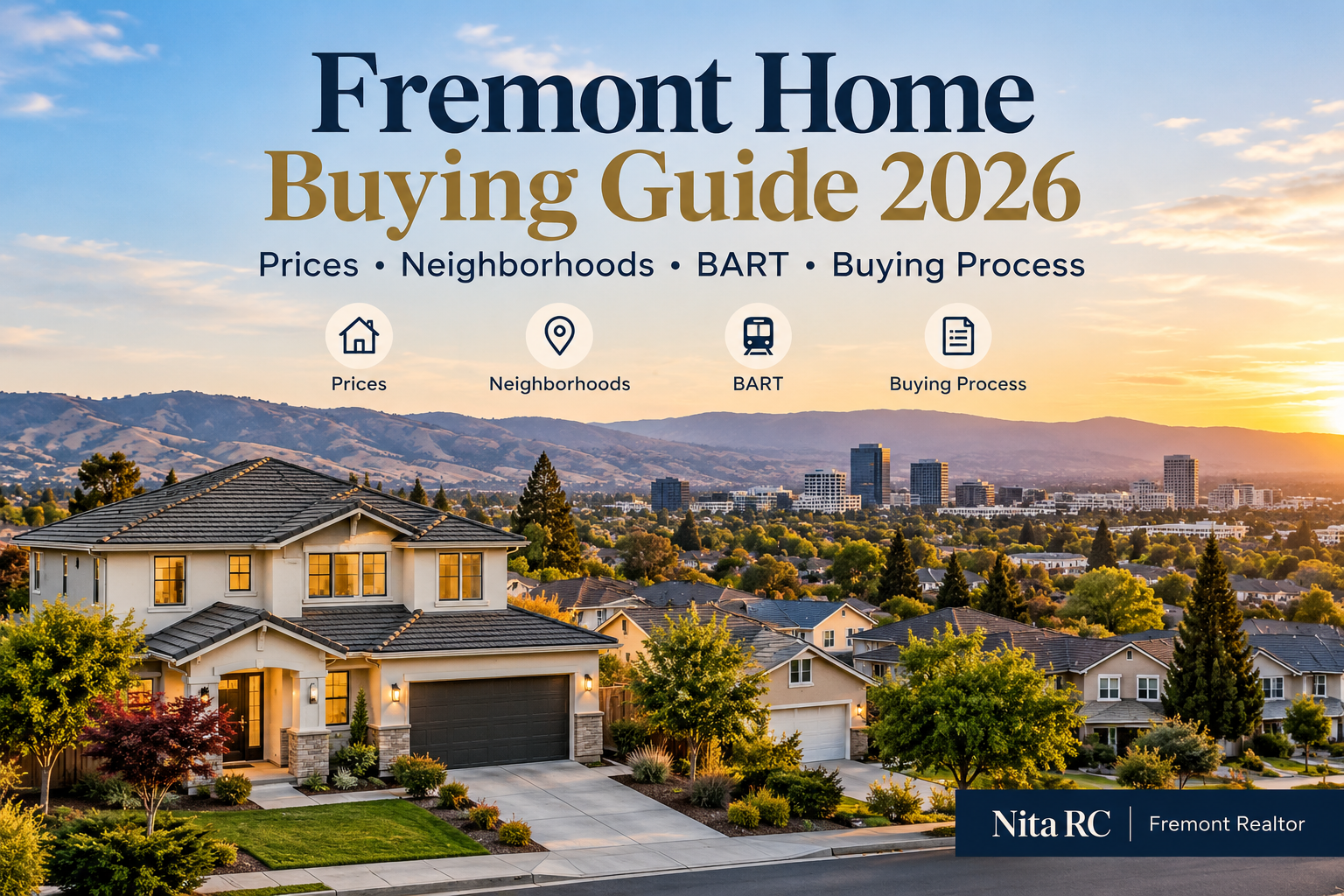
Why Fremont deserves a neighborhood-level buying strategy
Buying a home in Fremont is not simply a
matter of finding a property within a target price range. Fremont is a large,
diverse city with distinct districts, different housing stock, different
commute patterns and different buyer priorities. The City of Fremont identifies
Centerville, Niles, Irvington, Warm Springs and Mission San Jose as the five
historic districts that shaped the city, while today's housing market extends
well beyond those original districts. That history matters because a buyer can
experience a very different search depending on which part of Fremont fits the
household's work location, budget and lifestyle.
Current market data also argues against
using one citywide number as the definition of value. Realtor.com reported a
September 2026 Fremont median listing price of about $1.29 million and a median
sold price of about $1.335 million, with 384 active listings and a 31-day
median time on market. Redfin's August 2026 three-month data put the median
sale price at about $1.4 million and median days on market at about 19 days.
These figures use different time windows and methodologies, so they should not
be treated as contradictory. They demonstrate why buyers should compare
like-for-like properties and current neighborhood-level comparables rather than
rely on a single headline statistic.
Before touring homes, review the Fremont Realtor page to understand how Nita RC
approaches local searches, then use the Bay Area market reports for current market context. The
purpose is not to predict what a particular home will sell for. It is to
establish a framework for asking better questions.
Fremont market snapshot for September 2026
Realtor.com's September 2026 citywide
snapshot shows a $1.29 million median listing price, $1.335 million median sold
price, $814 per square foot, 384 active listings and 31 median days on market.
Its data also shows meaningful differences between neighborhoods. For example,
the reported median listing price was about $1.49 million in Ardenwood, $1.586
million in Niles, $1.15 million in Irvington, $1.32 million in Parkmont and
about $1.05 million in Central-Downtown Fremont. These are neighborhood-level
listing medians, not valuations of individual homes, and the small sample sizes
in some areas mean buyers should treat them as directional.
The important takeaway is that Fremont is
not one homogeneous market. A 1960s ranch, a newer townhouse near a transit
corridor and a larger home in a premium school-oriented area can have very
different buyer pools. Condition, lot size, remodeling, street location, school
assignment, HOA obligations, solar arrangements and proximity to transit can
all affect how a property competes.
Buyers should also distinguish between
asking price and market value. A list price is a seller's marketing decision.
Comparable closed sales, current competing listings and the property's specific
attributes provide a stronger basis for evaluating an offer. This is especially
important when a home appears inexpensive relative to a citywide median because
the difference may reflect property type, location, condition or a
neighborhood-specific market.
Choosing between Fremont neighborhoods
Start with the life you need the home to
support, then narrow the geography. Fremont's official city materials describe
the historic districts as distinct parts of the community, and the city also
emphasizes Fremont's transportation connections and diverse employment base. A
buyer who commutes toward San Jose may value a different location from a buyer
who travels toward Oakland, the Peninsula or works remotely.
Mission San Jose is often considered by
buyers who place strong weight on specific school-area considerations,
neighborhood character and access to the southern and central parts of Fremont.
The right way to research the area is not to rely on broad labels. Review the Mission San Jose neighborhood guide, verify
current school assignment information with the relevant district, and compare
the exact property against recent comparable sales.
Ardenwood can appeal to buyers who want a
North Fremont location with access toward the East Bay and Silicon Valley. The Ardenwood real estate guide is useful as a
starting point, but buyers should still evaluate individual streets, property
condition, commute patterns and current inventory.
Warm Springs and South Fremont are
particularly relevant to buyers who value access to BART and the broader
Silicon Valley employment corridor. The Warm Springs neighborhood guide can help frame
the search. Niles has a different character and housing mix, with its own
historic identity and proximity to Niles Canyon. Buyers interested in that part
of Fremont can start with the Niles real estate guide.
The goal is not to declare one Fremont
neighborhood the best. The goal is to identify the neighborhood that fits the
buyer's actual constraints.
BART, commuting and daily logistics
Transportation should be evaluated before a
buyer falls in love with a house. Fremont has two existing BART stations,
Fremont Downtown and Warm Springs/South Fremont, and the city says it is
working with BART on the design of a third station in the Irvington District.
The city also identifies AC Transit, Amtrak, Capitol Corridor and major
regional routes as part of the transportation network.
The official Fremont transportation page is the
appropriate source for current municipal transportation information. BART's
station information should be used for current station services, parking and
connecting transit rather than relying on old blog posts.
For a buyer, the practical question is not
simply 'Is this house near BART?' Ask how the household will actually use
transit. Measure the door-to-door trip, including the walk or drive to the
station, parking, transfer points and final connection to work. A home that is
two miles from a station may be more useful to one commuter than another
depending on the schedule and destination.
Also test the driving route at the times
you actually travel. Fremont's location gives it access to several employment
corridors, but the experience of a commute can vary substantially by
destination and time of day. If two households have the same budget but
different work locations, they may reasonably choose different parts of
Fremont.
How much should you budget beyond the purchase price?
One of the most common buying mistakes is
treating the down payment as the entire upfront budget. Closing can include
lender charges, appraisal, title and settlement-related costs, government
taxes, prepaid property taxes, homeowners insurance and other items. The
Consumer Financial Protection Bureau explains that closing costs vary and that
some costs may be negotiated or paid by another party depending on the
transaction, contract and applicable law.
California property taxes also deserve
attention. Proposition 13 generally limits the property tax rate to 1 percent
plus voter-approved bonded indebtedness and generally limits annual increases
in assessed value to 2 percent, but a purchase can trigger a reassessment. The
California Board of Equalization explains that a change in ownership can also
result in a supplemental assessment and one or more supplemental tax bills.
That means a buyer should ask the lender,
title or escrow provider and county assessor how the tax timing will work for
the specific transaction. Do not estimate the future tax bill by simply copying
the seller's current tax bill. The seller's assessed value may reflect a
different historical purchase price.
Homeowners association dues, special
assessments, solar financing or leases, insurance, maintenance and potential
renovation costs should also be included in the monthly and cash-to-close
analysis.
The Fremont buying process
1. Define the search. Decide the maximum
comfortable monthly payment, not just the maximum purchase price. Identify work
locations, commute limits, property type, neighborhood priorities and
non-negotiables.
2. Get financing organized. A pre-approval
can help establish a realistic budget and demonstrate readiness. Ask the lender
about rate assumptions, points, reserves, taxes, insurance and the total
estimated monthly payment.
3. Compare neighborhoods before comparing
houses. Visit at different times, review transit, understand the local street
pattern and verify information that matters to the household.
4. Review the property carefully.
California's Department of Real Estate advises buyers to consider inspections
and to understand disclosures. Depending on the property, this can include
general inspection, pest, roof, structural, electrical, plumbing, HVAC, solar
and other specialist evaluations.
5. Analyze the offer. Price is only one
component. Contingencies, financing strength, deposit, timing, credits and
other terms can affect the overall attractiveness and risk of an offer. The
California DRE notes that contingencies should be understood as part of the
offer and that buyers should read documents carefully before signing.
6. Complete due diligence. Review
disclosures, title information, inspections, loan documents, insurance and HOA
materials where applicable.
7. Close and plan the first year. Keep
records of closing documents, warranties, inspection reports and improvements.
Those records can become valuable when you eventually refinance, sell or
maintain the property.
First-time buyers: where discipline matters most
First-time buyers often focus on finding
the house and underestimate the value of preparation. In a high-cost market,
the better strategy is to establish a decision system before the search becomes
emotional.
Create three budgets: the maximum
lender-approved amount, the comfortable monthly amount and the maximum cash you
are willing to deploy. They are not necessarily the same. Keep a reserve for
repairs, moving costs, furnishings, insurance changes and unexpected expenses.
Ask for the full cost picture. The
California DRE's first-time buyer guidance specifically points consumers toward
HOA dues, special taxes and assessments, inspections, appraisals, disclosures
and escrow. Those are not administrative details. They can materially change
the cost and risk of ownership.
Finally, decide in advance which
compromises are acceptable. You may be willing to accept a longer commute for
more space, a smaller home for a preferred location, or a cosmetic renovation
for a better street. Making those decisions before touring helps prevent the
most expensive kind of compromise: buying a property that solves one problem
while creating several new ones.
Offer strategy in a changing market
Fremont's September 2026 data shows a
market with meaningful demand, but more inventory than a year earlier.
Realtor.com reported 384 active listings, up 12.5 percent year over year, while
the median listing price was down about 7 percent year over year. That does not
mean every buyer has leverage, nor does it mean every home will receive
multiple offers.
A disciplined buyer evaluates the specific
listing. How long has it been on the market? Has the price changed? Are there
comparable homes competing for the same buyer? Is the property turnkey or does
it require work? Are there unusual HOA, solar, title or disclosure issues?
An offer should be built around the buyer's
risk tolerance and the property's evidence. A strong offer is not automatically
the offer with the highest number. It is an offer whose price and terms make
sense for the buyer and are supported by the available information.
Expertise, evidence and a practical next step
Nita RC's role should be to help a buyer
turn broad market information into a property-specific decision. That includes
comparing neighborhoods, reviewing current competition, understanding the
transaction timeline and coordinating the professionals involved in due
diligence.
For buyers who are still narrowing their
budget, the first-time Bay Area buyer resource provides
another layer of preparation. Buyers comparing Fremont with San Jose can also
use the Fremont versus San Jose comparison rather than
evaluating the cities in isolation.
The right next step is not to rush into an
offer. It is to build a search that is specific enough to produce useful
comparisons. Once the budget, geography and property requirements are clear,
individual homes can be evaluated against evidence rather than emotion.
Frequently asked questions
Is Fremont expensive for home buyers?
Fremont is a high-cost Bay Area market. September 2026 Realtor.com data put the
citywide median sold price at about $1.335 million. Individual neighborhoods
and property types vary substantially.
How much money should I have before buying
in Fremont? There is no universal amount because down payment, loan program,
reserves and closing costs differ. Build a cash-to-close estimate with the
lender and escrow/title provider and maintain an emergency reserve.
Which Fremont neighborhood is best for
families? There is no universal best neighborhood. Compare the specific
household's school, commute, housing, budget and lifestyle needs, and verify
current school assignment information directly with the relevant district.
Is BART useful for Fremont homeowners?
Fremont has Fremont Downtown and Warm Springs/South Fremont BART stations. Use
current BART schedules and station information to evaluate the actual commute.
Should I use the seller's property tax bill
to estimate my taxes? No. A change in ownership can trigger reassessment and
supplemental taxes. Ask the county assessor or tax professional about the
specific property.
Do I need a home inspection? The California
DRE recommends buyers consider professional inspections. The appropriate
inspections depend on the property and transaction.