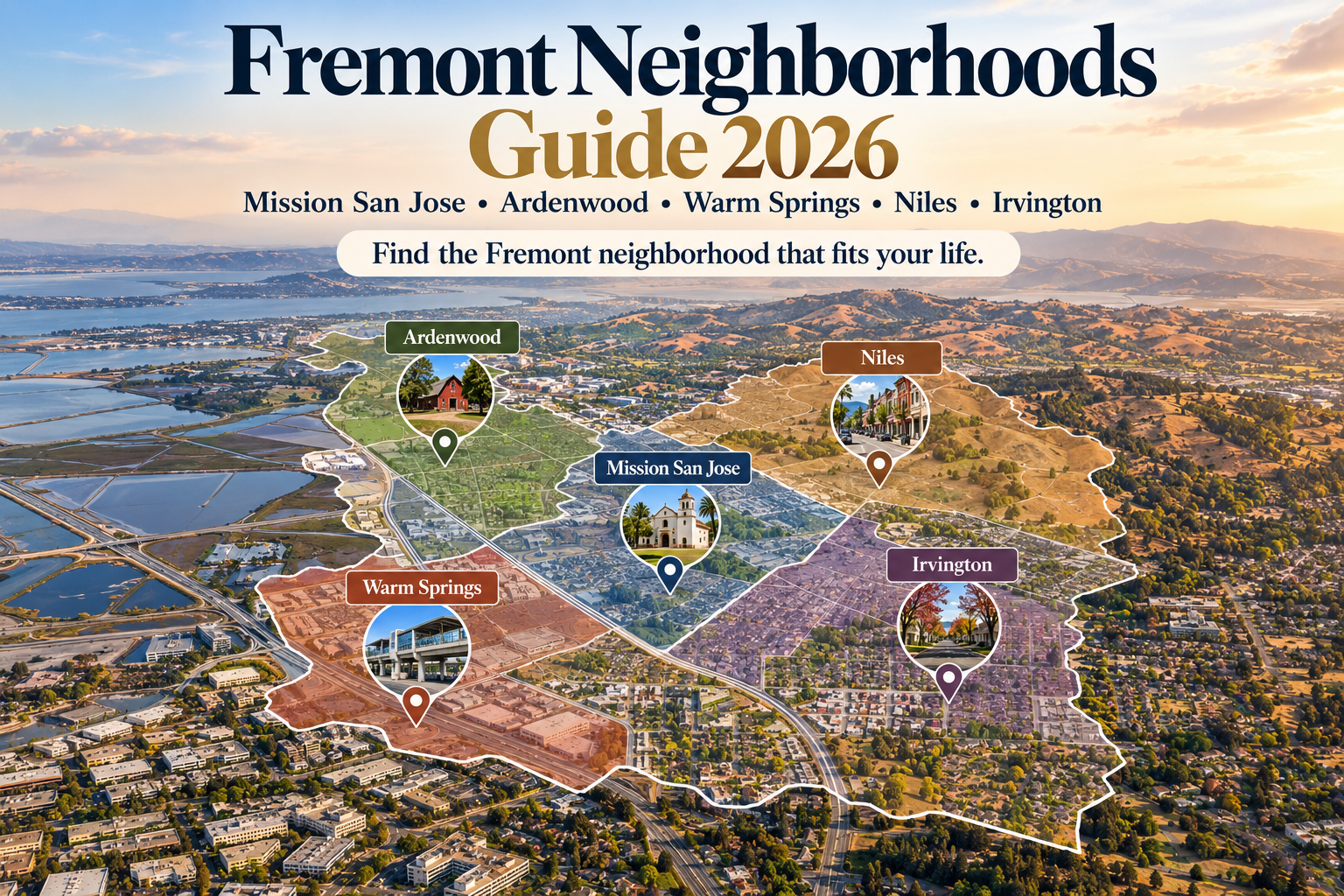
How to use this Fremont neighborhoods guide
Fremont is best understood as a collection
of distinct residential areas rather than a single housing market. The City of
Fremont identifies Centerville, Niles, Irvington, Warm Springs and Mission San
Jose as its five historic districts, each with its own character. Modern
Fremont also includes a much wider range of neighborhoods and housing types.
That distinction matters for searchers
because 'Fremont home' can describe a townhouse near a transit corridor, a
detached home in a family-oriented subdivision, an older property with a larger
lot, or a home in an area where school assignment and commute considerations
strongly influence demand.
Use this guide as a framework, then move to
the Fremont Realtor page for the current local
service offering and the individual neighborhood pages for deeper research.
Fremont at a glance
Fremont's population was estimated at
228,192 in 2024 by the U.S. Census Bureau. The same Census profile reports a
60.8 percent owner-occupied housing rate for 2020 to 2024, a median
owner-occupied home value of about $1.404 million, and a median household
income of about $181,506 in 2024 dollars. These figures provide useful context,
but they are not current home valuations and should not be substituted for MLS
or market data when pricing a property.
Realtor.com's September 2026 market data
put Fremont's median listing price at $1.29 million and median sold price at
$1.335 million. The site reported 384 active listings and 31 median days on
market. Its neighborhood table also illustrates why the citywide number can
mislead. Reported median listing prices ranged from about $699,000 in Warm
Springs and Cherry-Guardino to more than $2.19 million in Mission Valley.
Neighborhood figures can be volatile because inventory and property mix change.
The practical conclusion is simple: compare
a property to its actual competitive set. A citywide median can orient you, but
it cannot answer whether one particular home is fairly priced.
Mission San Jose
Mission San Jose has a distinctive identity
within Fremont and is one of the areas buyers frequently investigate when
school-area considerations, neighborhood character and access to central and
southern Fremont matter.
Buyers should separate reputation from
property-level due diligence. Verify current school assignment information
directly with the relevant school district. Review the exact street, lot, home
condition, renovation history and comparable sales. School boundaries and
enrollment rules can change, so a real estate website should not be treated as
the final authority on school eligibility.
The Mission San Jose neighborhood page is a useful
starting point for understanding the local housing search. For a buyer
comparing Mission San Jose with other parts of Fremont, look at the complete
cost of ownership and the daily commute, not just a neighborhood label.
Ardenwood
Ardenwood sits in North Fremont and can
appeal to households that need access toward the East Bay as well as Silicon
Valley. Realtor.com's September 2026 neighborhood data reported a median
listing price of about $1.489 million and $933 per square foot for Ardenwood.
Those numbers should not be interpreted as
a valuation for an individual property. Ardenwood contains different housing
types, sizes, ages and micro-locations. Compare recent closed sales and current
listings that are genuinely similar in size, condition, lot and location.
The Ardenwood real estate guide can support the
initial neighborhood research. Then evaluate the exact commute and property
characteristics before making an offer.
Warm Springs and South Fremont
Warm Springs is especially relevant for
buyers who value access to BART and the South Fremont employment corridor. BART
describes Warm Springs/South Fremont as being in the heart of Fremont's Warm
Springs Innovation District. The station connects to the Berryessa/North San
Jose and Daly City service patterns shown on BART's current station page.
The Warm Springs neighborhood guide is a useful
local starting point. Buyers should then check current BART schedules, parking
and connecting transit through BART itself because transportation details can
change.
Warm Springs also demonstrates why transit
proximity needs to be measured in real daily terms. A property may be
geographically close to a station but still require a drive, parking or another
connection. If transit is central to the buying decision, test the complete
door-to-door journey before making the location a deciding factor.
Niles
Niles has a different visual and historical
identity from newer parts of Fremont. The City of Fremont identifies Niles as
one of the city's historic districts and highlights its local businesses,
cultural character and historic assets.
From a real estate perspective, that means
buyers should pay close attention to the specific property and street. Older
housing can introduce different inspection questions, renovation histories, lot
configurations and infrastructure considerations than newer subdivisions.
Realtor.com's September 2026 neighborhood
data reported a median listing price of about $1.586 million for Niles. Again,
this is a listing-market statistic, not an appraisal. The Niles neighborhood guide can help frame the
local search.
Centerville and Irvington
Centerville and Irvington are important
parts of Fremont's original district structure and remain relevant residential
markets. Buyers considering these areas should compare housing stock, street
environment, transit access, commute direction and current competition.
Irvington is particularly interesting
because the City of Fremont says it is working with BART on the design of a
future station in the Irvington District. A planned project should not be
treated as if it were an existing service. Buyers should verify project status
directly with the city and BART before assigning value to a future
transportation improvement.
For Centerville and Irvington, the same
rule applies as elsewhere in Fremont: evaluate actual properties, not
neighborhood stereotypes.
Housing types and what they mean for buyers
Fremont's housing stock includes detached
single-family homes, townhomes, condominiums and other residential formats. The
right property type depends on budget, maintenance tolerance, household size
and long-term plans.
Detached homes can provide more privacy,
yard space and flexibility, but may carry higher purchase prices and
maintenance responsibilities. Townhomes and condominiums can provide a
different price point or lower exterior maintenance burden, but HOA dues,
rules, reserves and special assessments become important parts of the analysis.
For any HOA property, review the governing
documents, budget, reserves, recent meeting information and current or proposed
special assessments. Do not treat the monthly HOA fee as the only HOA
consideration.
Commute and transportation
Fremont has two existing BART stations,
Fremont Downtown and Warm Springs/South Fremont, and the City of Fremont says
it is working with BART on the design of a third station in Irvington. The city
also lists AC Transit, Amtrak and Capitol Corridor among its transportation
connections.
Use the official Fremont transportation information
for municipal context and current BART sources for station details.
Transportation should be tested against the actual work destination and
schedule.
A useful exercise is to create a commute
map for three candidate neighborhoods. Record the normal driving route, transit
route, approximate travel time, parking requirements and what happens on days
when the preferred route is disrupted. This turns 'good location' into a
measurable decision.
How to evaluate a home inside a Fremont neighborhood
Neighborhood research is only half the
decision. Once a buyer has narrowed the search to an area, the next step is
evaluating the individual block and property. Start with location within the
neighborhood. Two homes with the same ZIP code can have different traffic
exposure, access to major roads, proximity to transit, lot orientation, noise
levels and surrounding development.
Next, compare housing stock. Look at the
age and condition of nearby homes, the frequency of remodels, typical lot sizes
and whether additions are common. This can help a buyer understand what the
local competitive set looks like. A renovated home should not automatically be
compared with an unrenovated property simply because both are three-bedroom
homes.
Then look at the transaction evidence.
Recent closed sales are generally more useful for valuation than asking prices
because a closed sale shows what a buyer actually paid. Active listings are
still important because they represent the alternatives a current buyer can
choose instead. Pending sales can provide useful recent context when available.
Finally, spend time at the property at
different hours. Visit during the commute, evening and weekend if possible.
Listen for traffic, check parking, observe pedestrian activity and assess how
the property feels when the neighborhood is operating normally. Online maps can
narrow a search. They cannot replace being on the street.
Fremont neighborhood due diligence checklist
Before making an offer, a buyer should be
able to answer a short list of neighborhood questions. What is the current
school assignment for the exact address? What are the closest transit options?
What are the realistic peak commute times? Are there HOA obligations? Are there
known special assessments? What major development or transportation projects
are relevant to the area? Are there flood, fire, seismic or other hazard
considerations that need professional review?
Transportation plans deserve special care.
A planned station, road improvement or development project can affect a
neighborhood over time, but plans can change. Verify current status through the
relevant public agency before using a future project as a reason to pay more
for a property.
School information also requires
verification. Real estate guides can help explain neighborhood context, but
current attendance boundaries and enrollment rules belong with the relevant
school district. This is especially important when a buyer is making a decision
based heavily on a school assumption.
For property-level risks, use inspections
and professional reports. A neighborhood can be attractive while a specific
house still has drainage, roof, foundation, electrical or other issues.
How to use a local market report correctly
A market report should help a buyer ask
better questions, not tell the buyer what to pay. If a report shows that prices
have changed year over year, ask whether the change is visible in the
neighborhood and property type you are considering. If inventory has increased,
ask whether the additional inventory is competing directly with your target
home or is mostly made up of different housing types.
Review three layers of evidence: citywide
statistics, neighborhood statistics and property-specific comparable sales. The
citywide layer establishes context. The neighborhood layer narrows the market.
The property-level layer supports an offer decision.
Nita RC's [market reports]({market}) can
provide a starting point, but a current comparative analysis should be prepared
for the property itself. This is particularly important when a neighborhood has
a small number of transactions and the median can move substantially from month
to month.
How to compare Fremont neighborhoods without ranking them
Rather than asking which Fremont
neighborhood is best, score each candidate against your own criteria. Use
categories such as budget, commute, property type, lot size, transit,
neighborhood character, renovation tolerance, HOA exposure and long-term plans.
Give each category a weight. For example, a
commuter may assign a higher weight to transit and commute time, while a buyer
planning to stay for many years may place more weight on property type, lot and
neighborhood fit.
Then compare actual available homes. The
goal is to reduce the risk of choosing a neighborhood based on reputation
alone.
Local market research and next steps
The Bay Area market reports can provide broader market context,
but buyers should request property-specific comparable sales when evaluating an
offer. The market changes too quickly for a static neighborhood article to
substitute for current transaction evidence.
If you are moving from another city, the Bay Area relocation guide can help structure
the search around commute, budget and remote-buying logistics.
For buyers who are ready to compare homes,
the Fremont Realtor page provides the natural next
step.
Frequently asked questions
Which Fremont neighborhoods are near BART?
Fremont Downtown and Warm Springs/South Fremont have existing BART stations.
Verify current station access and route information with BART.
Is Mission San Jose the best Fremont neighborhood?
There is no universal best neighborhood. Suitability depends on
the buyer's priorities and current property-level evidence.
Is Ardenwood expensive?
Realtor.com's
September 2026 data reported a median listing price around $1.489 million, but
individual properties vary substantially.
Does Fremont have good transportation?
Fremont has BART, AC Transit, Amtrak and Capitol Corridor connections. The
usefulness depends on the household's actual origin and destination.
Should I compare neighborhoods by median price?
Use median prices only as context. Comparable properties and current
competition are more useful for evaluating an individual home.
Questions to ask before choosing a Fremont neighborhood
A useful neighborhood interview starts with
your own household. Ask which commute matters most, how much outdoor space is
actually needed, whether stairs are acceptable, whether an HOA is acceptable,
how much renovation work you can tolerate, and how long you expect to own the
home.
Then ask what evidence would change your
mind. If a neighborhood is attractive because of transit, verify the route. If
it is attractive because of schools, verify the exact assignment. If it is
attractive because of price, compare the current inventory and recent sales. If
it is attractive because of future development, verify the status with the
public agency.
This approach prevents a common mistake in
local real estate research: falling in love with a neighborhood story before
checking whether the actual property and daily routine fit.
Sources and further reading
City of Fremont, About Fremont