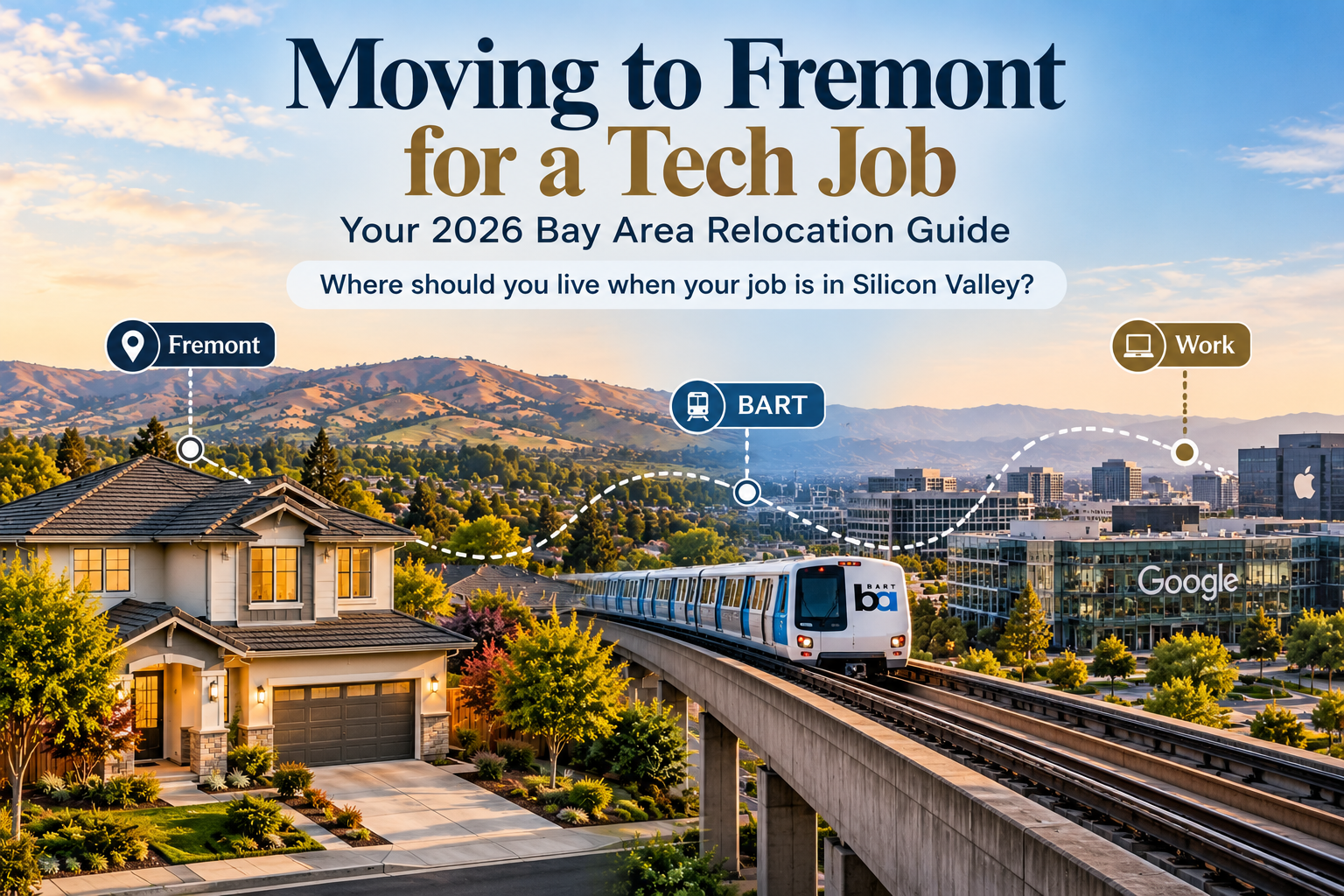
Why Fremont is on the radar for Bay Area relocations
Relocating to the Bay Area for a
technology, engineering, manufacturing or professional role creates a different
home-buying problem from a normal local search. You may know the employer,
compensation range and start date, but you may not know which neighborhoods
make sense, how long the commute will take, what housing type fits the budget
or how to complete a purchase while living outside California.
Fremont is particularly relevant because of
its location between major East Bay and Silicon Valley corridors. The City of
Fremont describes the city as the fourth largest in Silicon Valley and
highlights its advanced manufacturing base, transportation network, parks and
diverse community.
The right relocation strategy starts with
the work location. Do not choose Fremont simply because it appears on a list of
Silicon Valley cities. Determine where you will actually work, how many days
per week you will commute, and whether your household has one or multiple work
locations.
The Bay Area relocation resource can be used
alongside this guide to structure the move.
The Fremont market in September 2026
Realtor.com's September 2026 data reported
a Fremont median listing price of $1.29 million, median sold price of $1.335
million, 384 active listings and 31 median days on market. The median sold
price was down about 8.56 percent year over year, while active listings were up
12.5 percent year over year.
That combination creates a more nuanced
relocation market than the phrase 'Bay Area housing is competitive' suggests.
Buyers still need to be prepared for desirable homes, but they should also
analyze inventory, price changes and time on market rather than assuming every
listing requires an aggressive offer.
Relocation buyers should also compare
current data with the specific neighborhoods they are considering. Fremont's
market is not uniform.
Choose the commute before choosing the house
The most expensive mistake in a relocation
search can be choosing a house before understanding the commute. Start by
mapping the employer's office, expected office days and likely
arrival/departure times.
Fremont has two existing BART stations,
Fremont Downtown and Warm Springs/South Fremont. The City of Fremont also lists
AC Transit, Amtrak and Capitol Corridor among the transportation options
serving the city. The city says it is working with BART on the design of a
third station in Irvington, but a planned station should not be treated as
current service.
Use official Fremont transportation information
and current BART information when evaluating transit. For a tech worker,
calculate the complete journey from the front door to the workplace. A short
drive to BART may be useful, but only if the train route and final connection
fit the work schedule.
For hybrid employees, calculate both the
office-day commute and the remote-work lifestyle. A neighborhood that saves 20
minutes on office days may be worth considering even if it does not have the
lowest home price.
Which Fremont areas should a relocating buyer investigate?
Mission San Jose can be relevant for buyers
who prioritize particular school-area considerations and neighborhood
character. Start with the Mission San Jose guide and verify current
school information directly with the district.
Ardenwood can be useful for buyers who need
North Fremont access toward the East Bay and Silicon Valley. The Ardenwood guide can help frame the
neighborhood.
Warm Springs and South Fremont deserve
special attention from buyers who value BART and proximity to the southern
employment corridor. Use the Warm Springs guide and current BART data.
Niles offers a distinct historic character
and different housing context. Review the Niles guide and inspect older homes carefully.
Do not try to compare all Fremont
neighborhoods at once. Choose three that fit the commute and budget, then
compare actual listings.
How much house should a relocating tech worker buy?
Compensation can make Bay Area home prices
look manageable on paper while still creating a high monthly obligation. Build
the budget around the complete housing cost rather than the lender's maximum.
Include principal and interest, property
taxes, homeowners insurance, HOA dues, utilities, maintenance and an emergency
reserve. California property taxes also require special attention because a
purchase can trigger reassessment and supplemental taxes. The Board of
Equalization explains that supplemental bills can arise after a change in
ownership.
Do not count variable compensation such as
bonuses or equity as if it were guaranteed salary without understanding the
lender's underwriting rules and your personal risk tolerance. A relocation
purchase should remain comfortable if compensation or interest rates change.
The first-time Bay Area buyer guide is useful if
this is your first purchase.
Buying remotely from another state
Remote buying can work, but it requires a
more deliberate process. Begin with financing and a clear neighborhood brief.
Then identify a local agent who can explain the local market, arrange video
tours and coordinate access to inspectors and other professionals.
Ask for a process before you start touring.
How will homes be shortlisted? How quickly can a property be toured? Who
attends inspections? How are disclosures reviewed? How will offer documents be
explained? What happens if you cannot attend a final walk-through?
California's Department of Real Estate
provides consumer guidance on inspections, appraisals, disclosures and escrow.
Review those concepts before making an offer so the transaction timeline is
familiar.
A remote buyer should also understand the
difference between a virtual tour and a professional inspection. Video can help
you screen properties. It cannot replace appropriate physical due diligence.
Inspections and property risk
Relocation buyers sometimes feel pressure
to reduce due diligence because they are far away. That is the wrong place to
save time.
Depending on the property, consider general
inspection, pest, roof, structural, electrical, plumbing, HVAC, sewer,
drainage, solar and other specialist reviews. Older homes may require different
attention from newer construction. Townhomes and condominiums require HOA
document review as well.
California DRE guidance notes that
inspections are an opportunity to evaluate condition and value and that buyers
should consider professional inspectors. The exact scope should be based on the
property.
Use inspection findings to make an informed
decision. The goal is not to create a perfect house. The goal is to understand
the condition and the likely cost and risk of ownership.
Taxes and closing costs for newcomers
Relocating buyers should budget for more
than the down payment. Mortgage closing costs can include appraisal, title
insurance, government taxes and prepaid items. The CFPB recommends reviewing
the Loan Estimate and Closing Disclosure so the costs are understood before
closing.
California property tax treatment is
another area where newcomers can be surprised. Proposition 13 generally limits
the tax rate to 1 percent plus voter-approved bonded indebtedness and generally
limits annual assessed-value increases to 2 percent, but a purchase can reset
the assessed value and create supplemental assessments.
Ask the lender, escrow/title company and
county assessor questions specific to the transaction. Do not use a generic
online calculator as the final answer for a high-value purchase.
Compensation, equity and financing during a relocation
Relocation buyers often arrive with a
compensation package that includes salary, bonus, restricted stock units or
other equity. The purchase decision should be built around income that is
dependable and understood by the lender. A buyer should ask the lender how each
form of compensation is treated for underwriting rather than assuming every
component can be used in the same way.
Equity can also create a liquidity
question. A buyer may technically qualify for a large mortgage while still
needing cash for the down payment, closing costs, reserves and moving expenses.
Keep a separate relocation reserve so the home purchase does not consume every
available dollar.
If the buyer is selling an existing home,
the timing of that sale matters. The [Bay Area selling resource]({sell}) can
help frame the transaction, but the buyer should coordinate with the lender and
tax professional on the financial implications.
Interest rates also matter, but a
relocation decision should not depend on a perfect rate forecast. Compare the
payment under the rate available today with the buyer's comfortable budget and
evaluate refinancing as a separate future decision rather than assuming it will
happen.
Rent first or buy immediately?
Not every relocating employee should buy
immediately. Renting for a limited period can be sensible when the buyer has
not yet learned the neighborhoods, is uncertain about a long-term work
location, or expects a major household change.
Buying sooner can make sense when the buyer
has stable employment, a clear neighborhood preference, sufficient reserves and
a realistic plan to remain in the home long enough to absorb transaction costs.
The decision should be personal rather than driven by pressure to 'get into the
market.'
A short rental period can also be used
strategically. Spend the time testing commute routes, visiting neighborhoods at
different times, learning local services and observing the type of property
that actually fits the household.
If the buyer already knows Fremont well and
has a strong long-term reason to own, a direct purchase may be more
appropriate. The key is confidence in the location, not simply urgency.
A relocation due-diligence checklist
Before making an offer, confirm the exact
property address, school information if relevant, commute, insurance
availability, property tax expectations, HOA documents if applicable,
disclosures, inspection plan and financing.
Ask whether the property has solar
equipment and determine whether it is owned, financed or leased. Ask about
permits for major improvements. Review roof age, HVAC age, electrical service,
plumbing, windows and drainage where appropriate.
For condominiums and townhomes, review HOA
reserves, recent meeting minutes, insurance, rules and special assessments. A
low monthly HOA fee is not automatically a positive if the association is
under-reserved.
For remote buyers, establish who will
attend inspections and how the results will be communicated. Decide in advance
how documents will be reviewed and signed. A remote transaction should have
more process clarity, not less.
A 90-day relocation buying framework
Days 1 to 15: confirm employer location,
work schedule, budget, financing and must-have housing requirements.
Days 16 to 30: narrow to three or four
neighborhoods and research actual commute routes. Review current inventory and
recent comparable sales.
Days 31 to 60: tour homes, attend virtual
or physical inspections as appropriate, and refine the search based on actual
properties.
Days 61 to 75: prepare for offers, review
disclosures and establish an offer strategy based on the specific listing.
Days 76 to 90: complete escrow, coordinate
inspections, finalize financing, arrange insurance and prepare for the move.
These timeframes are illustrative. Bay Area
transactions can move faster or slower depending on inventory, financing,
contingencies and the individual transaction.
Why local experience matters for relocation
A relocation buyer is not only buying a
house. They are buying a location decision that affects work, family routines
and future flexibility. A local professional can help connect market data with
neighborhood-level realities.
Nita RC's local positioning can be reviewed
through the Fremont Realtor page, while buyers comparing
Fremont with San Jose can use the Fremont versus San Jose guide.
For a buyer who expects to sell another
home as part of the move, the Bay Area home selling resource can help
structure that side of the transaction.
Frequently asked questions
Is Fremont a good place to move for a tech job?
Fremont can fit buyers who need access to
Silicon Valley and East Bay employment corridors, but the right neighborhood
depends on the actual employer location and commute.
Can I buy a Fremont home before moving to California?
Yes, remote transactions are possible, but
financing, inspections, disclosures, escrow and local representation need to be
planned carefully.
Is Fremont cheaper than San Jose?
Current citywide medians are close, so
compare specific neighborhoods and properties rather than relying on a citywide
label.
Does Fremont have BART?
Yes. Fremont Downtown and Warm
Springs/South Fremont are existing stations.
Should I buy immediately after getting a Bay Area job?
Not necessarily. First establish the
commute, budget and neighborhood fit. Renting temporarily can be a rational
option if you need time to understand the market.
What a successful relocation search should produce
By the time a relocating buyer is ready to
make an offer, the search should have produced more than a favorite house. It
should have produced a defensible reason for choosing the neighborhood, a
realistic monthly budget, a financing plan, a due-diligence checklist and a
clear understanding of the commute.
The buyer should also know what would make
them walk away. That might be an inspection issue, an unacceptable commute, a
tax or HOA surprise, an insurance problem, or a price that no longer makes
sense after comparing current alternatives.
A disciplined relocation process does not
remove uncertainty. It makes the important uncertainty visible early enough to
make a rational decision.
Sources and further reading
City of Fremont, About Fremont